
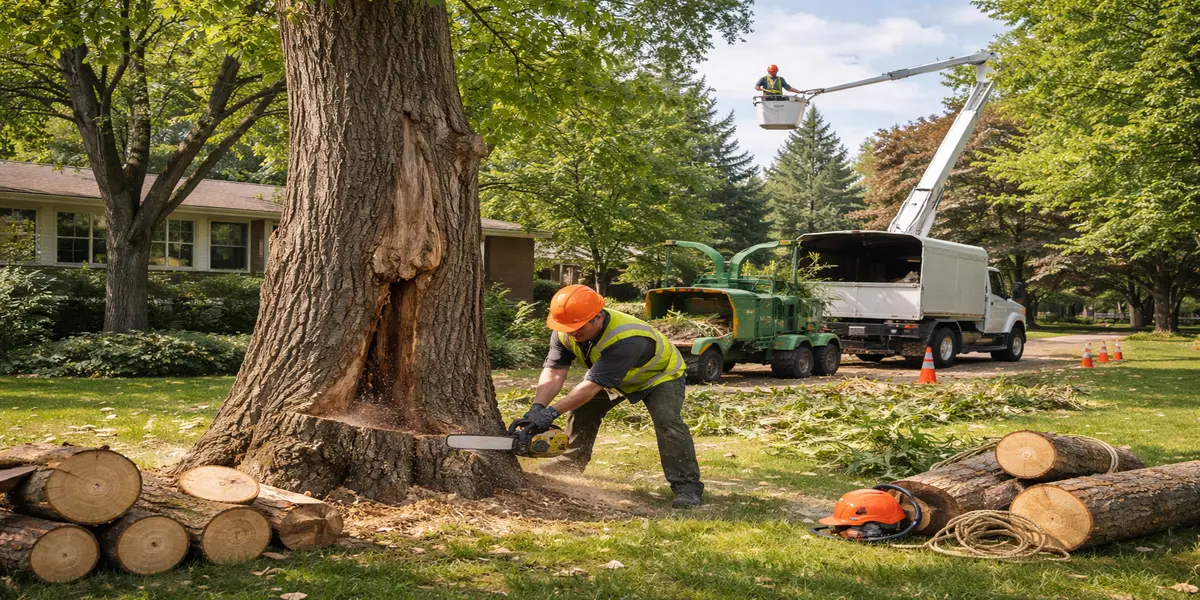
Remove a Tree: Best Time of Year for Safe Tree Removal
Do you ever wonder about a big tree down in your yard, whether it needs to be cut down-and when is the time of the year to cut it? This is one of the questions many homeowners have when the trees become too big, begin to display their traces of damages, or become dangerous to the surrounding buildings.
Although technically the process of removing trees can occur at any point of the year, the right time of the year should be used to ensure that the tree is removed safely, easily and at other times even inexpensively. Knowing when it is the right moment to cut a tree may save your home and make the task effective, as per tree experts.
The Importance of the Timing of the Removal of Trees
There is no simple cutting down of a trunk and clearing of the branches. It entails taking time in planning, being safe and knowing how trees respond during the seasons. Season may influence other aspects of weight on trees, foliage, groundwork and even the activity of pests. The strategy of removing at the correct season will easily make the work of professionals to reach the tree where they have to remove easier and will cause less harm to the surrounding environment, as well as carry out the operation without any harm.
Winter: Sometimes the Best Time to Remove Trees
Winter has in most instances been described as the most opportune season of the year to remove a tree. In winter, majority of the trees go dormant which entails that their growth is slowed down and they shed off the leaves. The lack of foliage makes clearing of the trees easier as the structure of the tree and any potential risks can be noticed by the professionals.
Besides, frozen or solid ground in colder seasons assists in minimizing the harm to lawns, gardens, and landscape. The company might also find it easier and less expensive to schedule the job faster, since trees service companies might have slightly lower demand in the winter season. Given all the above, it is common that during winter the weather is safer and easier to handle when removing trees.
Early Spring: Another Good Alternative
Early spring may also be appropriate time in which the tree may be removed, particularly before the trees enter the active growing season. The weather is normally pleasant at this period of the year and the trees are still comparatively light in terms of their branches provided that the leaves are not yet fully developed.
Early spring is also a time to cut a tree and ready your yard to be landscaped, or to plant new trees. Homeowners willing to redesign their landscapes usually take this period to clear the area of unwanted trees in order to embark on new activities.
Summer Removal: When Absolutely Necessary
Sometimes it is needed to remove trees during summer but not all the time. Waiting to winter may not be safe in case a tree gets diseased, seriously impaired, or starts leaning perilously during the growing period. If a tree becomes unstable or heavily damaged, it is important to understand the warning signs that indicate it may need immediate removal.
Summer storms may also cause weakening of trees and break branches or make them weak. When this occurs it is preferable to cut down the tree as soon as possible so that property in the form of houses and fences is not destroyed or close power lines harmed.
Fall: Fall Prevention of the Future
One can also use fall to clear off trees. This is the period when trees start shedding their leaves and retard their development. The period of transition may simplify the process of professionals evaluating the state of the tree and being able to dismantle it with ease.
Homeowners occasionally use fall to remove trees to make their property ready against winter storms, according to professional teams. Weak or damaged trees can be removed prior to the occurrence of heavy winds or snow falls, this could help minimize the chances of accidents and damage to properties.
Conclusion
Although cutting of trees can be done all year round, winter and early springs are usually regarded as the most optimal season due to inactive trees, enhanced visibility and less landscaping effects. Nevertheless, the safety must be in the first place. When a tree is unstable or dangerous, then it must be removed immediately and not at the right time as often described.